Enterprise AI adoption is accelerating at a pace few security architectures were designed to handle. Generative AI, agentic workflows, and non-human identities are rapidly reshaping how applications are built, how data flows, and where computation happens. As a result, long-standing assumptions about network security, visibility, and control are breaking down.
Across the industry, there is growing consensus on one point: traditional security models are not sufficient for the AI era. AI traffic behaves differently. It is faster, API-driven, non-human, and deeply contextual. Security teams are struggling to understand where AI is running, how data moves between systems, and which identities, human or machine should be trusted.
This is why Zero Trust has re-emerged as a foundational principle. But as AI becomes more decentralized, not all Zero Trust architectures are created equal.
AI Is Decentralizing Security, Not Centralizing It
For years, enterprise security strategies assumed that traffic could be routed through centralized inspection points from cloud gateways, PoPs, or perimeter controls where policies could be applied. That model is increasingly misaligned with reality.
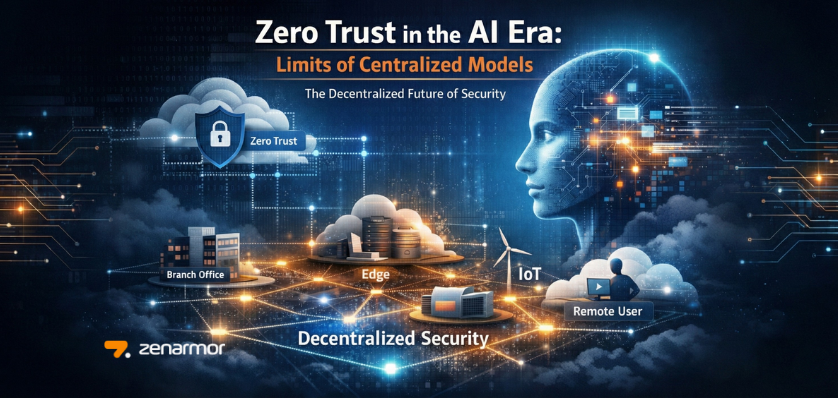
AI workloads are no longer confined to centralized cloud environments. They are being pushed:
- Closer to users
- Into branch locations
- Across private data centers
- Onto edge infrastructure
- Into hybrid and multi-cloud environments
As Zenarmor Founder and CEO Murat Balaban recently told CRN, in the context of analyzing AI vendor trends:
"As enterprises push compute, data and AI workloads closer to the edge, Zenarmor is investing in architectures that securely connect and protect these distributed environments. Enabling low-latency, secure connectivity and inspection across on-prem, cloud and edge infrastructure will be critical as AI workloads become more decentralized."
— Murat Balaban, CRN CEO Outlook 2026
This shift has profound implications for Zero Trust.
Visibility Alone Is Not Zero Trust
Much of today's AI security discussion focuses on visibility, discovering AI assets, mapping dependencies, and monitoring usage. While visibility is essential, it is not sufficient.
True Zero Trust requires more than knowing that AI traffic exists. It requires:
- Continuous verification
- Context-aware policy enforcement
- Least-privilege access decisions
- Immediate inspection and control
When enforcement depends on redirecting traffic to centralized inspection layers, organizations introduce latency, architectural complexity, and operational risk. In the AI era where performance, user experience, and real-time decisions matter, these tradeoffs become unacceptable.
Zero Trust cannot be an overlay. It must be embedded.
The Limits of Centralized Zero Trust Models
Centralized, PoP-based Zero Trust architectures were designed for a world where:
- Applications live in clouds
- Users connect from predictable locations
- Traffic patterns are human-driven and web-centric
AI breaks these assumptions.
AI traffic often:
- Originates inside private networks
- Flows laterally between services
- Uses non-standard protocols
- Involves machine-to-machine communication
- Requires sub-millisecond decisions
Routing this traffic through distant enforcement points increases latency, complicates troubleshooting, and creates new failure domains. More importantly, it delays enforcement, undermining the very principle of Zero Trust.
Zero Trust Must Execute Where Traffic Is Created
As AI decentralizes compute, Zero Trust enforcement must follow.
This is where architectural choices matter. Zero Trust enforcement must occur at the point where traffic is generated including branch, edge, device, and private environments, not after traffic is redirected elsewhere.
True Zero Trust for AI requires both context awareness and immediate enforcement in a single pass without introducing latency, routing changes, or architectural dependency.
Zenarmor approaches Zero Trust differently by delivering enforcement at the point where traffic is created, not after it is redirected. Through the Zenarmor SASE Anywhere Architecture™, Zero Trust controls operate consistently across:
- On-prem environments
- Branch locations
- Cloud workloads
- Edge infrastructure
- Remote users/devices
All inspection and policy enforcement occur in a single app, single stack, single pass, without dependency on centralized PoPs or traffic backhauling.
This approach enables:
- Sub-millisecond local inspection
- Consistent Zero Trust enforcement for AI and non-AI traffic
- Elimination of policy drift
- Lower operational complexity
- Faster adoption in brownfield environments
AI Security Must Work in the Real World
Most enterprises are not greenfield AI labs. They operate in complex, regulated, brownfield environments with:
- Existing networks
- Limited security teams
- Performance-sensitive applications
- Regulatory obligations
AI security that requires network redesign, traffic re-architecture, or additional layers of tooling creates friction and slows adoption.
Zero Trust for the AI era must adapt to existing environments, not demand that enterprises adapt to it.
This is especially critical as organizations balance innovation with compliance frameworks such as the NIST AI Risk Management Framework and the EU AI Act. Governance, reporting, and visibility matter but only when paired with enforcement that is immediate, local, and architecturally simple.
The Future of Zero Trust Is Decentralized
AI is forcing a rethinking of security fundamentals. The industry is moving away from perimeter-centric thinking and toward architectures that assume:
- Distributed compute
- Continuous verification
- Context-aware enforcement
- Performance without compromise
Zero Trust is no longer just about access, it is about execution.
As AI workloads continue to decentralize, security architectures must do the same. Those that rely on centralized inspection will struggle to keep pace. Those built to enforce Zero Trust everywhere traffic originates will be positioned to enable AI innovation without sacrificing security, performance, or control.
The AI era doesn't need more layers. It needs better architecture.